The Humanities Gathering highlights the role of critical thinking in the age of AI
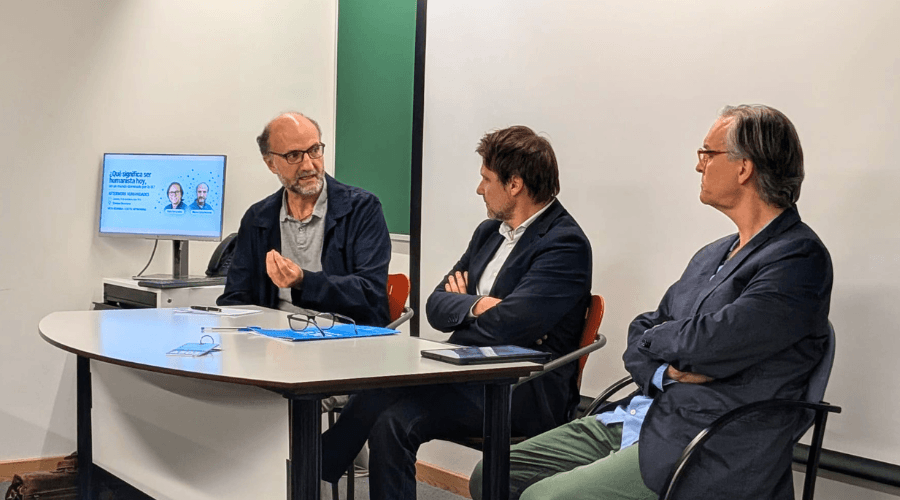
In a world increasingly influenced by artificial intelligence, what does it mean to be a humanist? This was the central question of the roundtable discussion featuring Marco Schorlemmer, a research scientist at the Spanish National Research Council’s (CSIC) Institute of Artificial Intelligence Research, and Gabriel Fernández Borsot, a member of the Faculty of Humanities at UIC. The discussion was moderated by Albert Moya, vice-dean of the Faculty of Humanities and Alumni coordinator
On 8 October, Alumni UIC Barcelona and the Faculty of Humanities held a new edition of the Humanities Gathering, bringing together students, teaching staff and alums from different graduating classes to share concerns and discuss issues affecting today’s society, including the place of human beings in technological development.
In his opening remarks, Moya underscored the value of this opportunity for dialogue and discussion on topics of shared interest.
One of the central themes of the discussion was the need to incorporate a humanistic perspective into the development of artificial intelligence. Schorlemmer emphasised that technology cannot be understood separately from the human goals, values and principles that guide its design. In this regard, the humanities can help identify and examine the implications of developing these tools.
Fernández-Borsot pointed out that, although machines can optimise objectives based on data, this does not guarantee that the outcomes will be acceptable from a human perspective. He therefore stressed the need to “reflect on how these objectives are defined and which criteria should guide the behaviour of artificial intelligence systems.”
The speakers also cautioned against the growing tendency to rely on these tools to do our thinking for us. Schorlemmer argued that humanists “must continue to exercise their reasoning skills”, while Fernández-Borsot highlighted the importance of reading, reflecting on and critically engaging with what we read.
In this context, Fernández-Borsot referred to the concept of “cognitive surrender”, which describes the relinquishing of one’s own judgement when reasoning is delegated to a technological tool. Both speakers stressed the importance of preserving human capacities that go beyond achieving objectives, such as moral judgement and reflection.
The discussion also addressed the impact of AI on professional fields and the possibility that it could eventually replace people in certain tasks. Fernández-Borsot expressed his hope that “technology can help expand human capabilities”, while highlighting the need to preserve faculties such as contemplation and inner depth. He also noted that the development of AI poses a social and political challenge, requiring decisions about which uses are desirable and where limits should be set.
In his closing remarks, Schorlemmer underscored the value of collaboration between humanists, computer scientists and engineers in bringing different perspectives to technological development. Fernández-Borsot, for his part, argued that humanists should integrate AI into their professional practice without relinquishing their critical spirit or depth of thought.