Arturo Pérez
Law | 2002
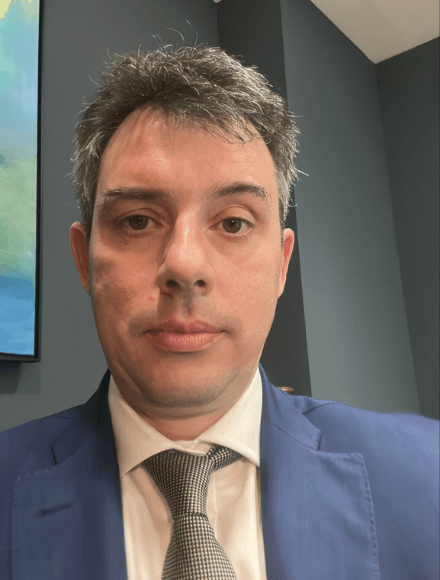
Arturo Pérez
Notary public
Law | 2002
Notarial advice is not merely a technical diagnosis. Many cases involve intangible factors that result in solutions which may go against what is expected or what initially seems most appropriate
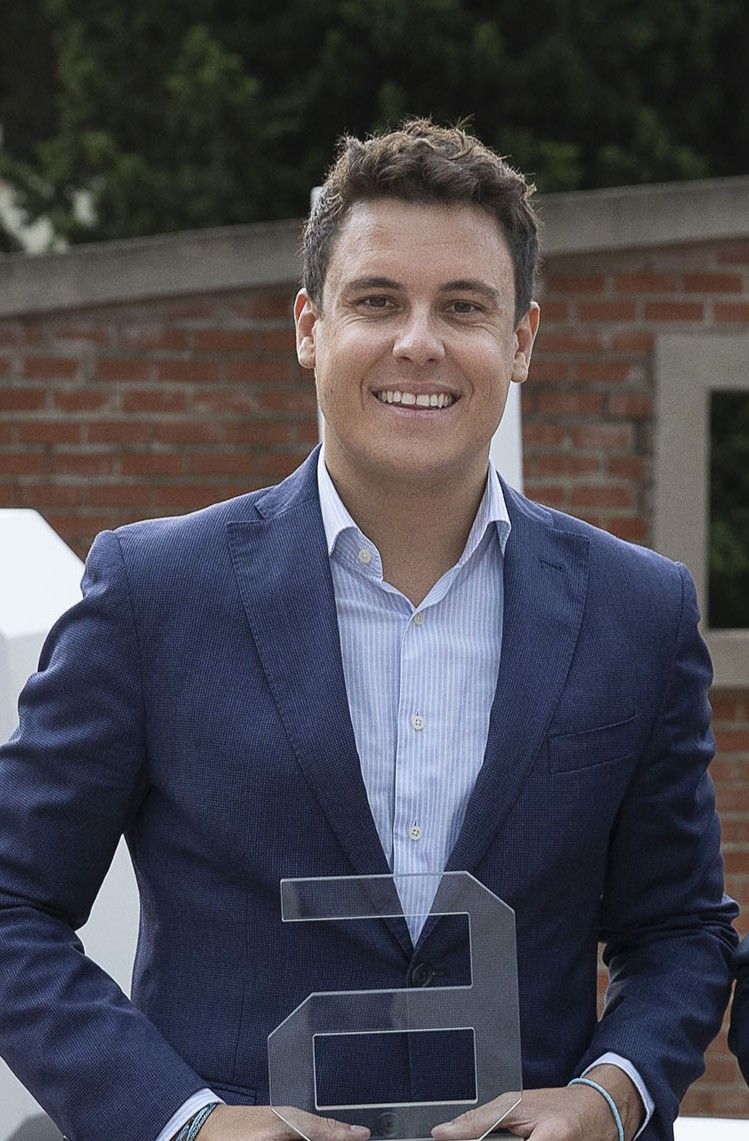
Arturo Pérez (Law, 2002) is a notary public and a member of UIC Barcelona’s second graduating class in Law. After choosing his degree for its career opportunities and taking on the competitive examination to become a notary public as a personal challenge, he discovered a strong vocation for a profession deeply connected to people’s lives. In this interview, he reflects on his professional journey, the lessons learned during his time at university, the evolution of the notarial role and the challenges the profession faces in an increasingly digitalised context, highlighting the human dimension of legal counsel and the social role of notaries.
- Who is Arturo Pérez? How would you describe yourself, and what motivates you in your daily work?
I am Arturo Pérez López, a notary public in Badalona and an alumnus of UIC Barcelona’s second graduating class in Law. While I enjoyed the degree, I initially chose Law somewhat “by elimination”, mainly because of the solid career prospects it offered. After completing my studies, I set myself the challenge of preparing for the public examination to become a notary public, without a particularly strong sense of vocation.
Now, as a notary, I have developed a true passion for this profession. Life passes through the notary’s office: from a minor’s emancipation to the merger of companies. Being in contact with so many people, each with very different issues, and having the opportunity to listen, counsel and support them, is deeply fulfilling. It gives me the sense that I’m helping others and making a valuable contribution to society.
- What lessons from your time at UIC Barcelona have had the biggest impact on your professional development?
When we started at UIC Barcelona, the Faculty was still very young, and there was so much to be done. I remember that it was the Law students who founded the University’s football team. That sense of teamwork – of competing together and defending the same colours – is something I also experience in the notary’s office. It, too, is very much a team effort, where everyone is eager to compete, and with its defeats and victories.
- How has the notarial profession changed since you started, and what new challenges does it face?
There is a trend in legislation and society to assign an increasing number of functions to notaries. While this helps lower the burden on other legal professionals, it can overload notary offices.
One of the things that surprised me the most when I started was the pace of work. Clients have high expectations, and the notary’s office is required respond, something that is not always easy. We place great trust in digitalisation and artificial intelligence to handle the more mechanical aspects of our work.
- Was there a key moment or mentor that influenced your decision to pursue a career as a notary public?
There were many people and many moments. I particularly remember a year in which I failed an oral examination. To understand what I’d done wrong, I went to watch the oral exams of other people taking the competitive exam. One colleague’s performance – his name was David Romanos – made a strong impression on me. I thought it was brilliant, and it gave insight into how I could express myself more effectively before the examination committee.
In the following sitting, we both passed, and I thanked him for it. He was very surprised; he didn’t even remember me.
- How do you think artificial intelligence will transform notarial work in the years ahead, and which aspects of the notary’s role do you believe will remain beyond the reach of technology?
Artificial intelligence will undoubtedly make many things easier for us, but it will never replace the purely human aspects of our profession. Notarial advice is not merely a technical diagnosis. Many cases involve intangible factors that result in solutions which may go against what is expected or what initially seems most appropriate.
Furthermore, when assessing capacity – that is, determining whether a person has sufficient discernment to sign a loan or a will – so many subtle nuances are involved that they can hardly be perceived by anything other than a human.
- A phrase that represents you: “Success is going from failure to failure without losing enthusiasm”
- Your favourite music: “Love Theme” from Spartacus
- Your favourite place: Rome
- A film or series you would recommend: Where Eagles Dare
- An anecdote from your time as a student at UIC Barcelona: Those were different times. We had spent all afternoon studying. Then, after dinner, in a moment of madness, the three of us rode on a single motorbike, without helmets, down Diagonal Avenue at full speed on our way to a nightclub. I was singing “I Want to Break Free” at the top of my lungs. Somehow, we weren’t fined. Mysteries of life. It’s not exemplary, I know, but it’s a memory that’s stuck with us . And now, of course, we’re all parents.