Clara Arrieta
Psychology | 2024
Giving and receiving feedback assertively is key, as well as high emotional intelligence, which enables understanding of human dynamics and the building of trust-based relationships without competition.
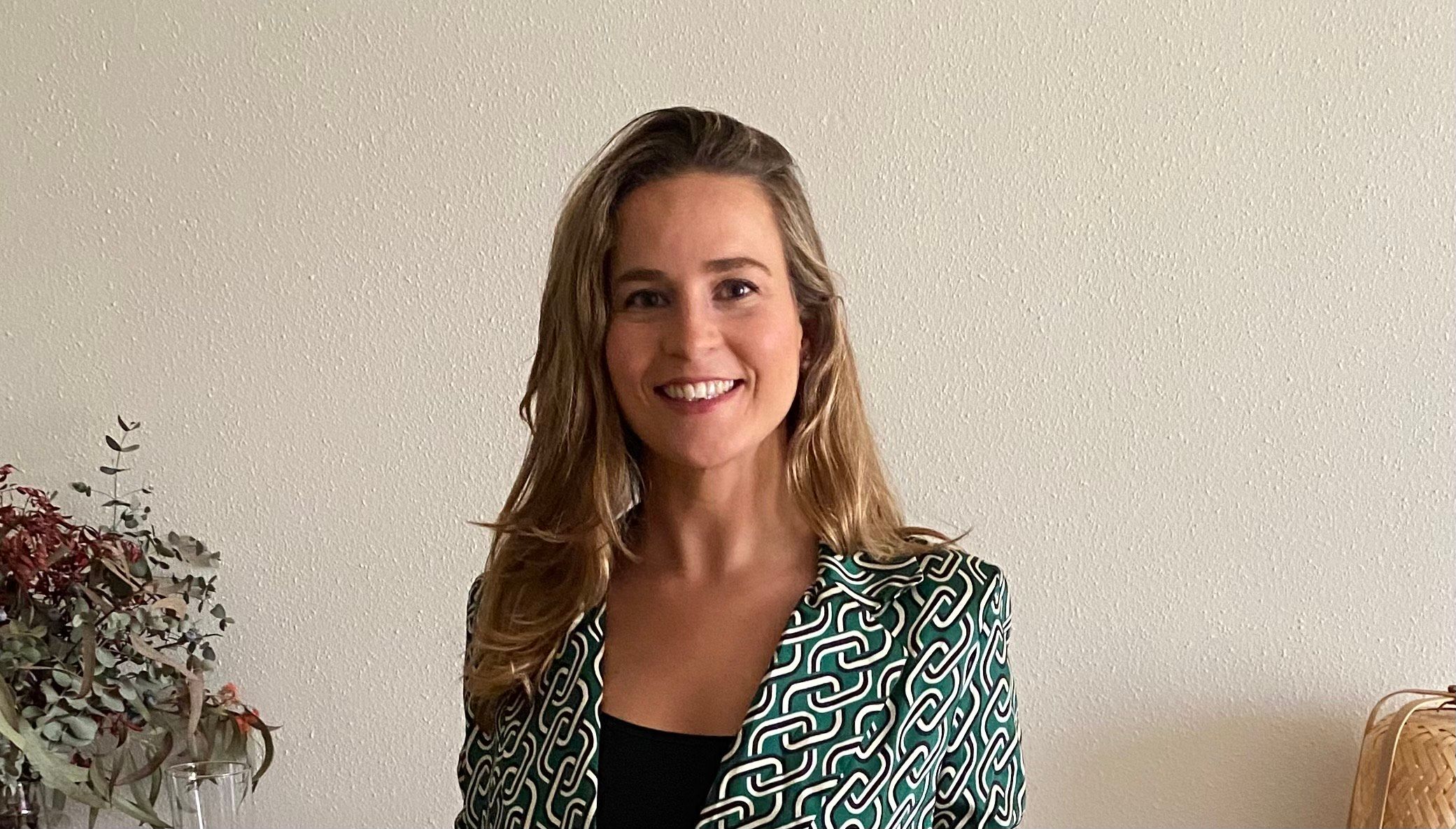
Clara Arrieta (Psychology, 2024) is Global Culture & People Engagement Specialist at Almirall. In this interview, she shares how her time at UIC Barcelona allowed her to develop transversal competencies such as assertive communication, critical thinking and self-awareness, which are key to both her personal and professional growth. Clara reflects on her motivation to work in Human Resources and People & Culture, her approach to promoting employee development and well-being in a multinational company and the essential skills in her field today. She also discusses the role of new technologies in her work, shares personal anecdotes and sources of inspiration and recalls the most significant moments of her university experience.
- Who is Clara Arrieta? How would you describe yourself and what motivates you in your daily life?
I am a girl from Barcelona, a lifelong tap dancer and deeply driven by an internal vocation to make a positive impact on people. I am motivated by connecting, sharing, conveying and making people feel good when they are with me, just as it makes me feel good to be with others.
I would describe myself as curious, entrepreneurial, with a critical spirit, authentic and optimistic, with a strong sense of humour. I am the type of energy that is action-oriented: I like to try new things, learn by doing, experiment, talk, listen, go out, travel, move around and explore the world. All of this is part of how I see life: living with purpose, love and freedom.
- What lessons from your time at UIC Barcelona have been most important for your professional development as a psychologist?
For me, my time at UIC was a deeply competency-based experience. Beyond theoretical training, it allowed me to cultivate and strengthen a series of skills that I now consider transversal and applicable to all areas of my life, both personal and professional.
I would especially highlight communication, and in particular, assertive communication: learning to express ideas clearly, concisely, respectfully and empathetically. In addition, my time at UIC Barcelona was a highly significant source of self-awareness. Over time, I have been able to recognise my strengths and work on other areas, such as gratitude, resilience and purpose.
Although I am certain that being a psychologist is in my DNA, today an important part of who I am comes from my time at UIC Barcelona and all the workshops and self-awareness activities I participated in. These spaces not only helped me grow as a student but also as a person, to communicate my value and maintain a continuous learning mindset. Essentially, being like a sponge, always observing and absorbing knowledge.
- What motivated you to focus on Human Resources and talent development?
Driven by my vocation to help, I began to realise that people spend a large part of their day at work, and that in many cases, this can become the core, or even the aggravating factor, of their discomfort. This awareness sparked in me the need to understand first-hand the reality of the corporate environment and its impact on people’s wellbeing.
I wanted to understand how personal purpose influences people when it is aligned, or not, with the company’s purpose and how to support people throughout the different life stages they go through in their professional journey: from moments of high motivation, meaning and engagement to stages of burnout or fatigue.
For this reason, my interest focused particularly on organisational culture. I understood that beyond isolated engagement initiatives, what truly fosters a healthy work environment, both mentally and physically, is building an authentic, coherent, flexible and sustainable culture that empowers people and allows them to reach their full potential.
- How do you contribute to employee development and training in a multinational company?
Primarily, I contribute by promoting a culture in which people development is a real priority, providing employees with the time, spaces and resources necessary to do so. However, I believe that resources alone are not enough: a true culture of learning and development is built from mindset, daily behaviours, and above all, leadership style.
I see culture as something living, created by people and sustained by the coherence between company values and each individual’s daily actions. For this reason, a key part of my contribution is supporting leaders in processes of self-awareness and self-reflection, so that they can develop the skills necessary to create healthy teams, with sustainable workloads and safe spaces for honest conversations and constructive feedback.
From this foundational work, centred on self-awareness, skills identification and development planning, the organisation can provide the right resources, such as training programs, coaching, mentoring or other learning initiatives. In this way, continuous growth is encouraged, which impacts not only professional performance but also the personal development of each employee.
- What skills do you consider essential for working in People & Culture today?
I believe that working in People & Culture today requires starting from a genuine vocation for service, understood as a real interest in supporting and caring for people within organisations. Added to this is a critical mindset, essential for questioning established practices and driving continuous improvements aligned with wellbeing and business strategy.
The ability to give and receive feedback assertively and honestly is another key skill, as well as high emotional intelligence, which enables understanding of human dynamics, conflict management and the building of trust-based relationships without competition.
Finally, I would highlight communication skills and learning agility, which are crucial for synthesising information, conveying ideas and applying learning across various contexts.
- What role do new technologies and digital tools play in your work?
Currently, new technologies and AI represent a paradigm shift. It is like the Industrial Revolution. We now have many resources that complement and enhance our value without replacing it. They make us more efficient in repetitive tasks, such as written communication or handling people data, allowing us to focus our time on high-value tasks like creating and strategising.
- A phrase that represents you: “Trust the process.” For me, this has great power for mental health and helps connect with the present, without regretting the past or worrying about the uncertainty of the future. It reminds me of the importance of accepting timing, embracing uncertainty and finding meaning even in moments of doubt. Trusting the process is, in many cases, a key tool to take care of mental health and move forward with greater calm and confidence, while remaining aware of our own control over what happens and knowing that if we don’t take the steps ourselves, no one will do it for us.
- Favourite music: Old hits that make me travel back in time, generally English pop like “Break Your Heart” by Taio Cruz or “Applause” by Lady Gaga.
- Favourite place: Being with myself and with the people I love. It’s not so much the place, but the people. It’s not about big trips or big houses. It’s having the freedom to choose what to do with your time and go where your heart is at peace. Still, I love places from the Cerdanya and Formentera to Asia in general!
- A book, film or series you recommend: The 7 Habits of Highly Effective People by Stephen R. Covey.
- A memory from your time at UIC Barcelona: The day I sat next to a friend on the train and didn’t notice because I was on my phone. That day marked a turning point as I realised how hyper-connected we are and it helped me to look up and pay attention to the world around me. I then began to truly enjoy train rides.
On the day I started my Organisational Psychology electives at the Barcelona campus, I accidentally walked into an elective class for the Business Administration degree. I stayed for the whole class so no one would notice. I never went back to that class again.