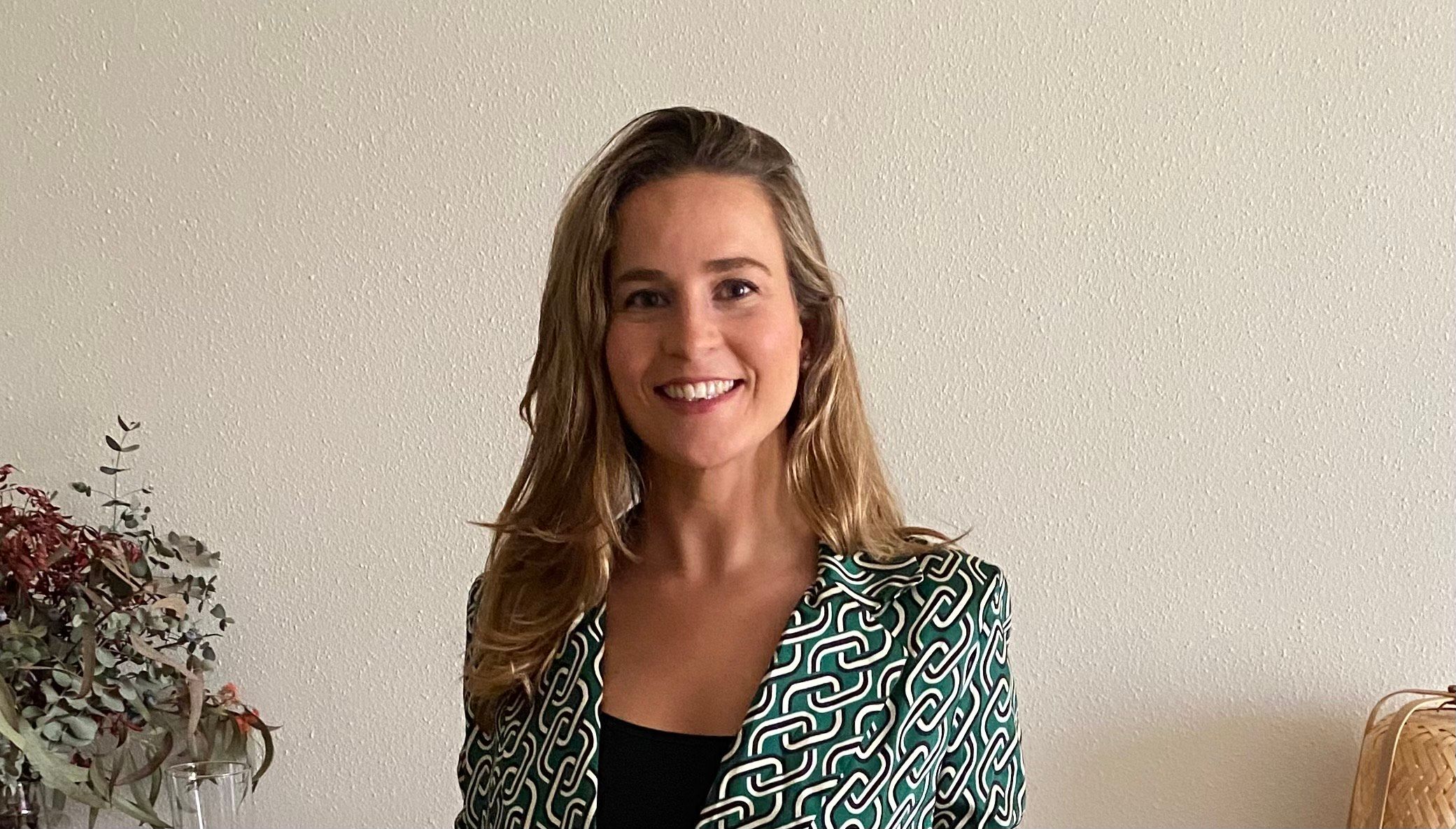
Laia Mariné
Biomedicine | 2022
Laia Mariné
Currently pursuing a PhD in Medicine at Hospital de la Santa Creu i Sant Pau
Biomedicine | 2022
The advances in AI make it possible to identify complex patterns that are not evident at first glance, integrate different types of data and improve predictive capacity.
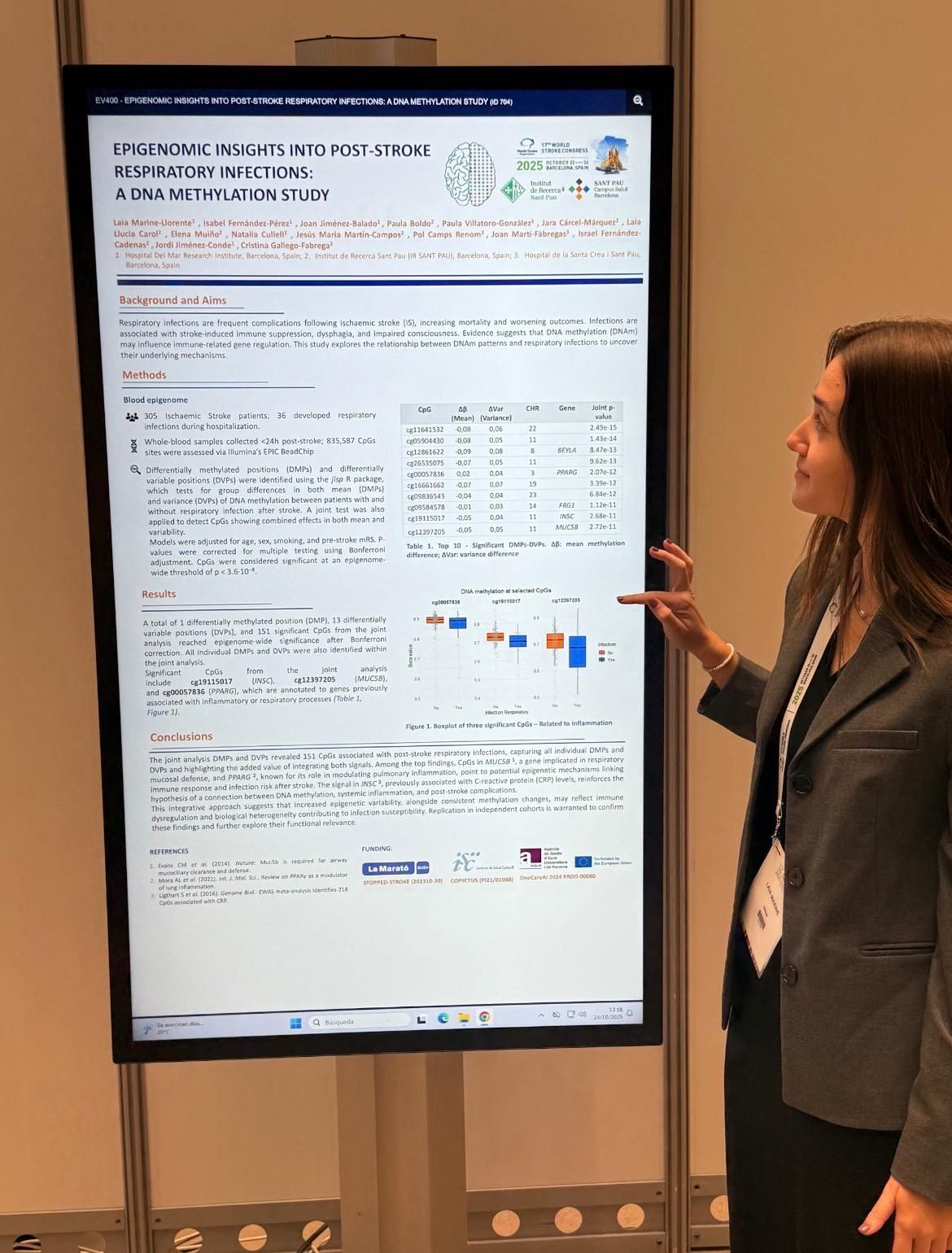
Laia Mariné (Biomedical Sciences, 2022) is currently pursuing a PhD in Medicine at Hospital de la Santa Creu i Sant Pau, where she researches the integration of omics data to improve prognosis in patients who have suffered an ischaemic stroke. In this interview, she shares her vocation for translational research, her interest in genetics applied to real patient data, and the key skills she has developed throughout her academic and scientific career.
- Who is Laia Mariné? How would you describe yourself and what motivates you in your daily work?
I am currently a PhD student in Medicine at the Universitat Autònoma de Barcelona (UAB) and I am carrying out my doctoral thesis at Hospital de la Santa Creu i Sant Pau, focused on the integration of omics data to assess the functional prognosis of patients who have experienced an ischaemic stroke. I live in Sant Sadurní d’Anoia, in the Penedès region. I love the mountains, but I also highly value living close to the sea.
From an early age, I wanted to become a doctor. I have always been passionate about understanding what happens inside the human body and how that knowledge can help to heal. Driven by this curiosity, I decided to study Biomedical Sciences, a degree that allowed me to delve deeper into disease mechanisms and potential treatment options, especially in conditions such as stroke, with the aim of ensuring that this knowledge reaches people and contributes to improving their quality of life.
For all these reasons, I would describe myself as a curious person, eager to learn and to turn that learning into something useful for others. My daily motivation is to keep learning and to know that, over time, this knowledge can be translated into improvements in patient care.
- What lessons from your time at UIC Barcelona have been most important for your professional development?
I believe that my time at UIC Barcelona, over the four years of my degree, can clearly be divided into two phases.
The first two years were quite chaotic. I had not yet figured out how to study, how to approach exams or how to balance coursework with laboratory placements. That stage taught me how to manage frustration and to accept that things do not always turn out as expected. Over time, I have realised that this learning is crucial, especially during a PhD, where results are not always immediate and one must learn to tolerate uncertainty.
The third and fourth years were very different. By then, I had learned how to study effectively and how to make the most of each subject. I started to organise myself better, set priorities and, above all, enjoy what I was doing more. Although it was a period with a heavy workload and less free time, I learned how to optimise my time, “create time where there seems to be none,” and maintain motivation even during highly demanding periods.
Overall, my experience at UIC Barcelona provided me with very important tools for my professional development: organisational skills, frustration management, perseverance and, above all, learning to enjoy the process, even when it is not easy.
- What led you to specialise in advanced genetics?
There was no single defining moment, but rather an interest that developed progressively over time. Genetics had always caught my attention; in fact, my final high school project already focused on prenatal screening using maternal blood.
During my undergraduate placements, which later became my Bachelor’s Degree Final Project, I worked at Hospital del Mar in a genetic editing group using CRISPR. There, I learned techniques to modify gene expression in stem cells, an experience that confirmed my interest in continuing to deepen my knowledge of genetics.
During my master’s degree, I continued working within the same group, consolidating these techniques, and I began working at Hospital de la Santa Creu i Sant Pau, in the group where I am currently based. There, I started working more directly with patient data and participating in meetings of the International Stroke Genetics Consortium, which allowed me to understand the potential of genetics applied to real diseases and its clinical impact.
From that point on, I was certain that I wanted to shape my career toward translational research, working with patient data and applied genetics, and taking the step into a PhD felt like a natural decision.
- Which skills are essential to conduct research in such a demanding field as human genetics?
From my perspective, to conduct research in human genetics – and in fact in any field – it is essential to have critical thinking skills and a solid understanding of the problem you aim to solve. It is not just about generating data, but about knowing how to interpret it, question it and understand the scientific question behind it.
Being organised and methodical is also key, especially when working with large datasets and long-term projects. In addition, the ability to work as part of a team is essential in human genetics, where research is clearly multidisciplinary. Each profile brings different expertise, and knowing how to collaborate, communicate and learn from other specialists is crucial for a project’s progress.
From a more technical and scientific standpoint, I consider it very important to have a strong foundation in molecular biology, as well as a solid understanding of the disease being studied, its pathophysiological processes and existing knowledge gaps, in order to explore them further.
Furthermore, when working with patient data and large cohorts, having a strong grounding in statistics and a good understanding of epidemiology is essential, both to analyse results correctly and to interpret and extrapolate them at a population level.
- Given the fast pace of scientific innovation, which trends or advances do you consider particularly relevant for this field?
Today, given the volume and complexity of the data we work with, I believe that advances in machine learning and artificial intelligence are particularly relevant. We are generating increasing amounts of both omics and clinical data, and traditional tools are not always sufficient to integrate them and extract all the information they contain.
These methodologies make it possible to identify complex patterns that are not evident at first glance, integrate different types of data and improve predictive capacity – an essential aspect when working with prognosis, risk or treatment response.
Moreover, I believe these advances are especially important because they help bring research closer to clinical practice. When applied correctly, these tools can contribute to better decision-making, improved patient stratification and, ultimately, progress toward more personalised, data-driven medicine, which is the direction in which the field is moving.
- Once you complete your PhD, which new projects or areas would you like to explore?
I still have some time left before completing my PhD, but I would like to continue working in the field of genetics and personalised medicine. I enjoy research very much, but I feel that I would like to work more closely to the patient.
I would like to explore areas where I can combine research and clinical practice and see how everything I have learned in genetics and data analysis can ultimately have a more direct impact on people. I believe this is where my work finds the greatest meaning.
- A phrase that represents you: Nothing great is created by dedicating only the time you have left over.
- Your favourite music: Spanish pop from the 2000s.
- Your favourite place: El Penedès.
- A book, film or series you recommend: How to Make Good Things Happen, by Marian Rojas.
- An anecdote from your time at UIC Barcelona: When our degree programme was closed just before we were due to start. It was later reopened, and we were ultimately able to complete it. I would say it is the anecdote that everyone in my cohort remembers.